Powered by Blogger.
RSS
Showing posts with label Victorian. Show all posts

Tales From Research Part #2

Today, we continue the immortal journey of the Fonthill Abbey through a historical incidence. We know the abbey's main tower collapsed in 1825 and the whole manse was demolished thereafter. In my reality, the west wing, where the Fourth Earl of Wiltshire's room resided, was burned down by an act of revenge.

The first pages of the Great
Reform Act 1832.
The Representation of the People Act 1832, or Great Reform Act of 1832, influenced by the French Revolution, was an Act of Parliament in England and Wales which introduced more seats into the House of Commons from large cities and took away seats from smaller cities called "rotten boroughs". It also increased the amount of voters from 400,000 to 650,000.

Charles Gray
The Whigs favored reform, constitutional monarchy, and parliamentary rule. The Duke of Wellington's opposition to reform forced his resignation from office and he was succeeded by Charles Gray who pushed parliamentary reform with the Whigs. After much debate, the House of Lords and its majority of Tories, who advocate monarchism, supported the Church of England, and opposed reform, consented to the Bill after a threat by King William IV of revolution as all as the Birmingham Political Union led by Thomas Attwood (Oliver and Rosalind Attwood's father) and 15,000 supporters who threatened to use violence, to desist their opposition.

Two years later, the modern-day Conservative Party was created with similar philosophies to conservatism (traditionalism) and British unionism.
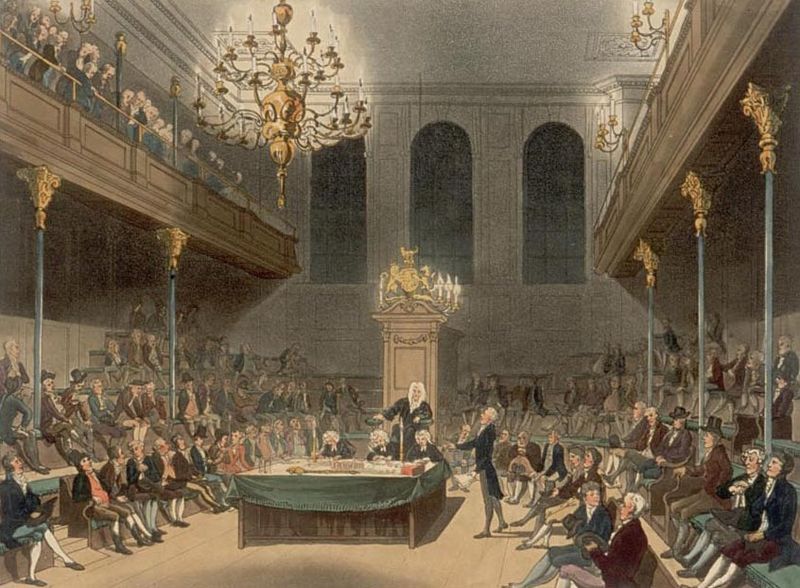
House of Commons
Effects of the Act: Since 60% of the people, specifically "male persons", were allowed to vote, 95% of the population were left without the vote, including women. In addition to being the first statutory bar to women's suffrage, most of the pocket boroughs belonged to Tory members, and tenants-at-will were created to allow voting for whomever their landlord told them to, allowing the Tories to retake the House of Commons in 1841.

The Great Reform Act of 1832 was also proceeded by protests and riots. And this is where we come to quick of our story. During a time of political turmoil and possible revolution, the middle class radicals believed in threatening the government into change. They started writing letters to influences like the Duke of Wellington and then posted them in the newspaper, waiting for a positive response from the public. After receiving no response from the politicians they wrote, the radicals moved onto the more violent means of protest. They rioted, attacking the Duke of Wellington's and the bishops' houses in London. The castle at Nottingham was burned down, as well as several serious riots appeared in Derby, Worcester, Bath, and many more. All victims were anti-reformers, Tories, and wealthy landowners. The Bristol Riot, the most destructive, consisted of 500 to 600 young men and lasted for three days, where private homes and property were looted and destroyed. Almost 100 people involved in this attack were tried in January 1832 and four men were hanged.

The 3rd Dragoon Guards violently suppressing the Bristol Riots of 1831.
Queen's Square, 20 October, 1831.

Attacks that occurred after the Reform Bill passed in 1832.

I thought there was no reason why the Earl of Wiltshire, William Kendall's late father, who was an anti-former, Tory, and wealthy aristocrat, couldn't become a victim of these attacks. 

So, this is where the real story begins...

As always, thank you for reading.


Happy writing!
Image and video hosting by TinyPic

  • Digg
  • Del.icio.us
  • StumbleUpon
  • Reddit
  • RSS

Tales From Research

Today, I wanted to share a piece of history with everyone. When I first started my research on a perfect place for my Victorian series (over 5 years ago), I would never imagine finding the perfect setting for them all in a mysterious Gothic Revival building called the "Fonthill Abbey." I checked all over Google for a place as befitting a reclusive Earl as I could find in Wiltshire, England and found:

Fonthill Abbey
This wonderful manse is what started it all. My dreams about the Victorian Era and its many interesting facets. I could actually see people living in this place throughout the 19th Century. My aristocratic family, the Kendalls, began living here around 1832 when they bought the house from John Farquhar. They would continue to spend 40 years or more in the immortal abbey. Unfortunately, in real life, the building didn't last nearly as long as it did in everyone's memory.


So, this is where our story starts...at the beginning...

William Beckford in 1782 by George Romney
In 1760, William Thomas Beckford was born in London. Ten years later, he inherited 1,000,000 pounds (or 110 million pounds in 2012) from his father, as well as land at Fonthill in Wiltshire and sugar plantations in Jamaica. Later, he became a novelist and an art collector. After accusations of having homosexual relations,  he married Lady Margaret Gordon and exiled himself to the Continent where he traveled to Switzerland, Italy, Germany, Spain, France, and Portugal. Then his wife died of childbirth.

When he returned to England, he enclosed around Fonthill Estate a six-mile long wall to prevent poachers from entering his property. Due to his romantic nature, Beckford wanted a Gothic cathedral constructed as his home. In 1796, the architect, James Wyatt, began work on the building using timber stuccoed with cement. Francis Eginton, a glass painter, desgined thirty-two depictions of medieval knights, kings, etc. for the many windows. 950 laborers worked day and night to build the abbey. After the first 300 foot tower collapsed, the new one was finished six years later only to collapse as well. The final one, built in stone, was completed in seven years. In 1813, the abbey's construction was done.  
Abbey tower ruins.

Beckford lived alone in the 500-acre abbey until 1822 spending wealth without making it, only occupying one of the rooms. After losing two sugar plantations, he was forced to sell the the property and its entitlements for 330,000 pounds to an ammunition dealer named John Farquhar. In 1825, the main tower collapsed, and later the rest of the abbey was demolished. The gatehouse and part of the north wing remain to this day. Speculation arose that since Beckford rushed the construction of the Fonthill Abbey, with the absence of the architect many times during the project, and the enormous height of the tower spire, the building was doomed from the beginning. So, they labeled it "Beckford's Folly." William Beckford died in 1844 in Bath, England.

Highlights from the Fonthill Abbey:

Great Western Entrance Hall

Grand Drawing Room
The Great Octagon


King Edward's Gallery on the West wing


This tower spanned about 300 feet tall.
St. Michael's Gallery on the East wing

(Information about the Abbey courtesy of Wikipedia and a collection of maps and descriptions by John Rutter called Delineations of Fonthill and its Abbey.)

I guess you can say that research/history is an obsession of mine. I will continue to include this abbey in my series, because it deserves immortality. If I had the money, I would recreate this masterpiece (maybe not in England), and I would definitely make it much more sturdy than wood with stucco covering it. I will always dream about it. At least, the abbey's legacy lives with the Kendall family.

Thank you for reading and your ongoing support. :)


Happy writing!
Image and video hosting by TinyPic

  • Digg
  • Del.icio.us
  • StumbleUpon
  • Reddit
  • RSS